Entry to the main walking paths costs 25,000 IDR in cash. The valley opens daily from 07:00 AM to 06:00 PM, but arriving before 09:00 AM helps you avoid the heavy midday heat and large tour buses.
Tegallalang Rice Terrace operates daily from 07:00 AM to 06:00 PM. Arrive between 07:00 AM and 09:00 AM to beat the intense valley humidity and avoid the large tour buses that pull in after 10:00 AM. Heavy overnight rain can leave the lower valley paths completely impassable the next morning.
| Day | Hours | Note |
|---|---|---|
| Monday–Sunday | 07:00 AM – 06:00 PM | Visits average 1 to 1.5 hours; arrive early for the best conditions. |
The terraces remain open year-round, operating without official holiday closures. Severe weather during the November to February rainy season frequently shuts down the steep lower sections of the 600-meter valley. Check local conditions before your 9 km drive from Ubud, as the clay trails turn slick and dangerous after heavy downpours.
General admission to the main walking paths and viewpoints costs 25,000 IDR. You must pay in cash at the official booths, as credit cards are not accepted.
Prepare extra small bills for the local farmers. Crossing private land or small bamboo bridges requires donations of 10,000 to 20,000 IDR.
No regular free entry days exist, and advance bookings are not required.
Planning your visit to Tegallalang Rice Terrace? Find tours with free cancellation and skip-the-line options.
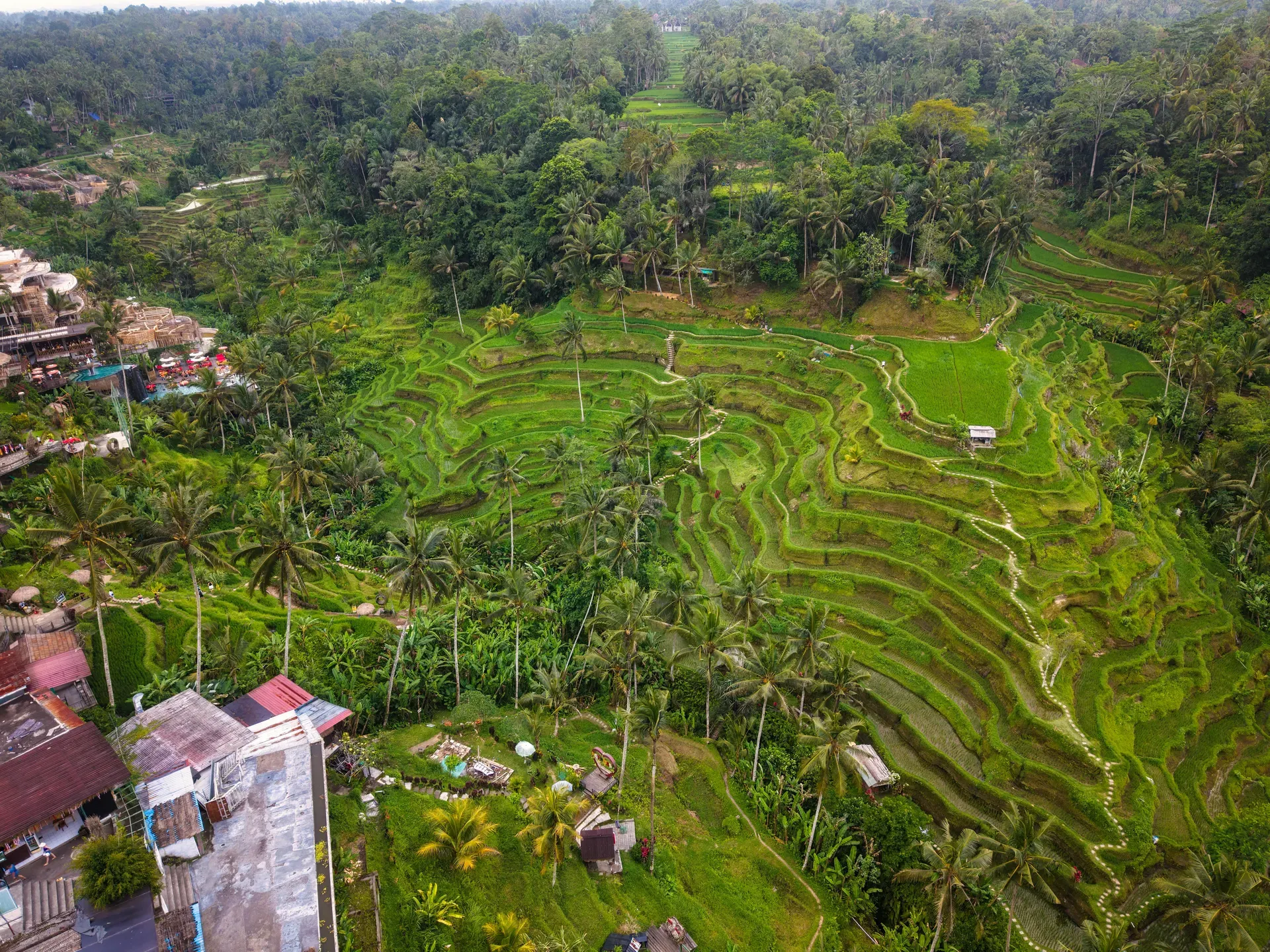
View All ToursArrive between 07:00 AM and 09:00 AM during March, April, September, or October for the greenest paddies. Sunrise light filters through palm trees into the misty valley before large tour buses arrive at 10:00 AM. Avoid the November to February rainy season, which turns the steep dirt paths into slick mud.
Plan for 1 to 1.5 hours to explore the three main levels of the Tegallalang Rice Terrace. Trekking the 1,000-foot elevation change on narrow dirt paths dictates most of your schedule, though heavy overnight rain often leaves the lower valley impassable. Adding a stop at the infinity pool cafes or waiting for the Bali Swings will easily double your stay.
Get there between 07:00 AM and 09:00 AM. Tour buses flood the area after 10:00 AM, clogging the narrow dirt paths. The valley floor traps heat and humidity later in the day, making the 1,000-foot elevation change much harder.
Keep 5,000 and 10,000 IDR bills handy. Local farmers maintain the private land and expect small donations at various crossing points. Handing over 10,000 IDR is the standard rate, but watch out for locals demanding excessive fees at small bamboo bridges.
Buy the 25,000 IDR entry ticket only at the official booths. Fake ticket sellers often approach tourists near the roadside parking areas. Credit cards are not accepted anywhere on the site, including the donation points.
Lace up shoes with heavy tread. The clay-like soil on the steep, uneven stone steps turns slick with even light moisture. Paths lack safety railings, and a slip means falling directly into a muddy paddy or down a steep drop.
Visit in March, April, September, or October to see the crops at their greenest. Harvest turns the terraces golden-brown shortly after. Heavy rain from November to February turns the steep dirt paths into impassable mud.
The terraces open daily from 07:00 AM to 06:00 PM. Arrive between 07:00 AM and 09:00 AM to beat the valley floor humidity and avoid the large tour buses that pull up after 10:00 AM. Photographers catching the sunrise 'golden hour' will see light rays filter through palm trees into the morning mist.
General entry costs 25,000 IDR. Official ticket booths operate on-site and only accept cash in Indonesian Rupiah. Ignore the fake ticket sellers who often approach tourists in the parking lots.
No advance permits or reservations are required. You buy tickets directly at the entrance. Roadside parking adds 5,000 IDR for scooters and 10,000 IDR for cars.
Expect to pay small donations of 10,000 to 20,000 IDR when crossing private land maintained by local farmers. Bring 5,000 and 10,000 IDR notes for these multiple bamboo bridge checkpoints. Specific photo spots, nests, and the Bali Swings charge separate fees ranging from 10,000 IDR to 350,000 IDR per person. Locals demanding excessive fees for bridge crossings are running donation scams; stick to the standard 10,000 IDR.
No formal religious dress code applies here since it is an agricultural site, not a temple. Leave the sarongs behind. Wear light, breathable clothing and shoes with heavy tread. The clay-like soil on the narrow dirt paths becomes slick with even light moisture.
Trekking the loop involves a 1,000-foot elevation gain and loss. The descent requires navigating steep, uneven stone steps and narrow dirt tracks without safety handrails. Heavy rain from November to February often makes the lower valley paths completely impassable. Wheelchair users cannot access the valley floor but can view the complex from the flat roadside sidewalk or the Abian Desa viewpoint.
The terraces shift colors throughout the growing cycle. March, April, September, and October offer the brightest green stalks right before harvest. Fields turn golden-brown just prior to cutting and become muddy brown during replanting. Heavy rain the night before turns the lower valley paths into a slippery mud trap.
Browse verified tours with free cancellation and instant confirmation.
Find Tours